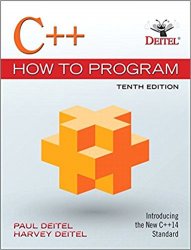
Название: C++ How to Program, 10th Edition
Автор: Paul J. Deitel,? Harvey Deitel
Издательство: Pearson
Год: 2016
Страниц: 1080
Формат: PDF, EPUB
Размер: 113 Mb
Язык: English
C++ How to Program presents leading-edge computing technologies in a friendly manner appropriate for introductory college course sequences, based on the curriculum recommendations of two key professional organizations–the ACM and the IEEE.
The best-selling C++ How to Program is accessible to readers with little or no programming experience, yet comprehensive enough for the professional programmer. The Deitels’ signature live-code approach presents the concepts in the context of full working programs followed by sample executions. The early objects approach gets readers thinking about objects immediately–allowing them to more thoroughly master the concepts. Emphasis is placed on achieving program clarity and building well-engineered software. Interesting, entertaining, and challenging exercises encourage students to make a difference and use computers and the Internet to work on problems. To keep readers up-to-date with leading-edge computing technologies, the Tenth Edition conforms to the C++11 standard and the new C++14 standard.


C++ How to Program, Fifth Edition
Print ISBN:
0-13-185757-6
Web ISBN (SafariX):
0-13-186103-4
© 2005
pages: 1536
Professors and Instructors: Contact your Prentice Hall representative to request an examination copy. Locate your Prentice Hall representative.
Order from Amazon or InformIT:

Free Online Deitel C++ Tutorials
- Major content revisions.
- Smaller chapters.
- Early classes and objects approach.
- Integrated case studies: GradeBook, Time class, Employee class and more.
- Unified Modeling Language 2.0 (UML 2.0) and an optional OOD/UML ATM case study developed over Chapters 1-7, 9 and 13.
- Discussion and illustrations of the compilation and linking process for multiple-source-file programs.
- Function-call stack explanation.
- Early introduction of C++ Standard Library string and vector objects.
- Discussion and illustration of how polymorphism works «under the hood.»
- Web programming, CGI and XHMTL.
|
Standard Template Library (STL).
ANSI/ISO C++ Standard compliance.
New debugger appendices (Visual Studio .NET and GNU C++).
New interior design.
Syntax coloring consistent with most C++ integrated development environments and code editors.
Code testing on multiple platforms.
Errors and warnings shown for multiple platforms.

Question 1
Package-delivery services, such as FedEx®, DHL® and UPS®, offer a number of different
shipping options, each with specific costs associated. Create an inheritance hierarchy to
represent various types of packages. Use Package as the base class of the hierarchy, then
include classes TwoDayPackage and OvernightPackage that derive from Package. Base
class Package should include data members representing the name, address, city, state and
ZIP code for both the sender and the recipient of the package, in addition to data members that
store the weight (in ounces) and cost per ounce to ship the package. Package’s constructor
should initialize these data members. Ensure that the weight and cost per ounce contain
positive values. Package should provide a public member function calculateCost that
returns a double indicating the cost associated with shipping the package. Package’s
calculateCost function should determine the cost by multiplying the weight by the cost per
ounce. Derived class TwoDayPackage should inherit the functionality of base class Package,
but also include a data member that represents a flat fee that the shipping company charges for
two-day-delivery service. TwoDayPackage’s constructor should receive a value to initialize this
data member. TwoDayPackage should redefine member function calculateCost so that it
computes the shipping cost by adding the flat fee to the weight-based cost calculated by base
class Package’s calculateCost function. Class OvernightPackage should inherit
directly from class Package and contain an additional data member representing an additional
fee per ounce charged for overnight-delivery service. OvernightPackage should redefine
member function calculateCost so that it adds the additional fee per ounce to the standard
cost per ounce before calculating the shipping cost.Write a test program that creates objects of
each type of Package and tests member function calculateCost.
Question 2
Use the Package inheritance hierarchy created in Question 1 to create a program that displays
the address information and calculates the shipping costs for several Packages. The program
should contain a vector of Package pointers to objects of classes TwoDayPackage and
OvernightPackage. Loop through the vector to process the Packages polymorphically.
For each Package, invoke get functions to obtain the address information of the sender and the
recipient, then print the two addresses as they would appear on mailing labels. Also, call each
Package’s calculateCost member function and print the result. Keep track of the total
shipping cost for all Packages in the vector, and display this total when the loop terminates.
|