
I have successfully upload image in nodejs and I am using multer for that. But sometime » Array buffer allocation failed » error occurs and I want to handle that error. I tried to keep the code in try-catch block even though still it throws the error and I am unable to figure out how to handle this error or how to avoid that error ? Able to upload file but when I try to change height and width and making a new image then it throws an error
OR
Any suggestion will be much more helpful

- 2 Answers 2
- Not the answer you’re looking for? Browse other questions tagged arrays node.js image buffer or ask your own question.
- Related
- Hot Network Questions
- JavaScript. Быстрый старт
- Comments
- dcposch commented Sep 2, 2016 •
- This comment has been minimized.
- dcposch commented Sep 2, 2016
- This comment has been minimized.
- dcposch commented Sep 2, 2016 •
- Ideas for how to fix this in webtorrent.js / fs-chunk-store
- This comment has been minimized.
- DiegoRBaquero commented Sep 2, 2016
- This comment has been minimized.
- feross commented Sep 15, 2016
- This comment has been minimized.
- disarticulate commented Oct 22, 2017 •
- This comment has been minimized.
- disarticulate commented Oct 22, 2017 •
- This comment has been minimized.
- disarticulate commented Oct 22, 2017
- This comment has been minimized.
- disarticulate commented Oct 22, 2017
- This comment has been minimized.
- disarticulate commented Oct 22, 2017
2 Answers 2
Looks like you do not have enough memory to perform a large size upload
jpeg-js uses inadequate amount of memory for image processing,
— possible solution could be to resize picture (imagemagick/whatever)

Not the answer you’re looking for? Browse other questions tagged arrays node.js image buffer or ask your own question.
Related
Hot Network Questions
To subscribe to this RSS feed, copy and paste this URL into your RSS reader.
site design / logo © 2019 Stack Exchange Inc; user contributions licensed under cc by-sa 4.0 with attribution required. rev 2019.11.15.35459
Дата публикации: 2016-10-07

От автора: приветствую вас, друзья. Из этой небольшой статьи мы с вами узнаем, как увидеть и исправить ошибки JavaScript. Статья написана для начинающих изучение JavaScript.
При написании программы на любом языке программирования так или иначе не обходится без ошибок, которые необходимо уметь найти и исправить. В качестве примера давайте напишем простейшую программу, которая должна показать модальное окно:
В этой простейшей программе есть ошибка JavaScript, которую нам и нужно найти, поскольку с ней наш код не работает и модальное окно не показывается. Мало того, в JavaScript многие ошибки можно назвать фатальными, поскольку из-за них может прекратить работу не только ваш скрипт, но и сторонние библиотеки JavaScript до тех пор, пока ошибка не будет исправлена.
JavaScript. Быстрый старт
Изучите основы JavaScript на практическом примере по созданию веб-приложения
Что же поможет найти ошибки JavaScript? Консоль браузера. Здесь мы вкратце пройдемся по этому инструменту в различных браузерах, в частности это будет Firefox и Chrome. В обоих браузерах консоль есть из коробки.
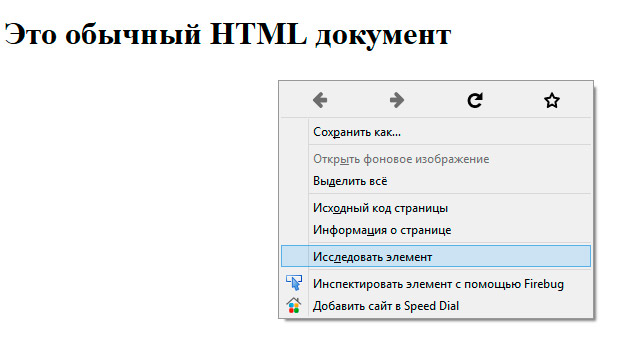
Начнем с Firefox. Для того, чтобы увидеть ошибку в нашем коде, необходимо открыть консоль браузера. Для этого кликаем в окне браузера правой кнопкой мыши и в контекстном меню выбираем пункт Исследовать элемент.
Внизу окна появится панель, в которой мы можем исследовать и отлаживать наш код. Полагаю, если вы верстали сайты, вы уже могли использовать этот инспектор кода для исследования верстки. Инструмент значительно упрощает жизнь верстальщика, даже и не представляю, как раньше верстали сайты без него
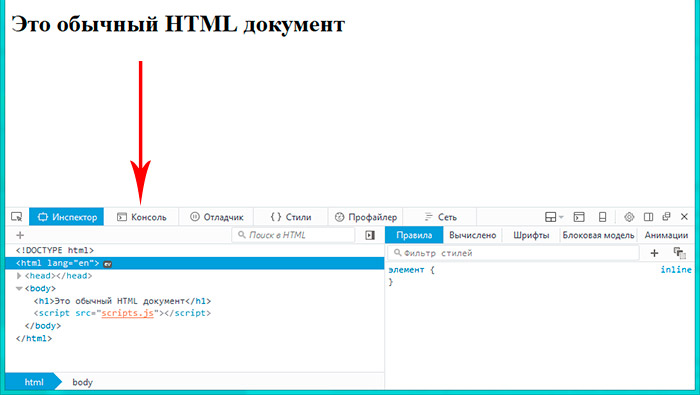
Итак, в открывшейся панели рядом со вкладкой Инспектор есть вкладка Консоль, она то нас и интересует. Переключимся на нее, еще раз обновим страницу и увидим все ошибки JavaScript. В нашем случае это всего одна синтаксическая ошибка, которая произошла в файле scripts.js на первой строке.
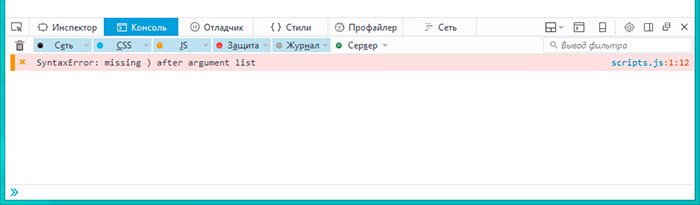
Нам остается лишь перейти в данный файл, заметить, что мы забыли заключить строку в кавычки и исправить эту ошибку:

Вот теперь ошибок нет и код успешно выполнился. Кроме встроенной консоли для Firefox можно отдельно установить расширение Firebug, которое, по сути, является аналогом. После установки Firebug можно вызвать, как и встроенную консоль, из контекстного меню или использовать для этого горячую клавишу F12. Вот таким образом выглядит Firebug:

Ну и консоль Хрома:

Она также вызывается из контекстного меню или клавишей F12.
Конечно, для исправления ошибки в единственной строке кода консоль зачастую не нужна. Но если кода десятки и сотни строк, тогда без консоли обойтись практически нереально. При этом в консоли можно не только смотреть ошибки, но и даже писать собственный JavaScript код, но это уже тема отдельной статьи.
На этом статья подошла к концу, теперь вы знаете, как найти в своем коде ошибки JavaScript и исправить их. Если вы хотите больше узнать о JavaScript, тогда рекомендую обратить свое внимание на уроки по JavaScript и отдельный курс по языку JavaScript. Удачи!
JavaScript. Быстрый старт
Изучите основы JavaScript на практическом примере по созданию веб-приложения

JavaScript. Быстрый старт
Изучите основы JavaScript на практическом примере по созданию веб-приложения
Comments
Copy link Quote reply
dcposch commented Sep 2, 2016 •
|
This is currently the most frequent uncaught error in the WebTorrent Desktop telemetry. It comes from the underlying library.
As you can see above, we’ve only seen this error on Windows.
One reason why a buffer allocation can fail is because the OS is out of memory. I don’t think that’s the case here, though. It affects even systems with lots of memory:
Finally, when this bug starts happening to someone, it tends to happen a lot. Of the
4000 WebTorrent Desktop telemetry reports from yesterday, only 19 contained this error, but each of those had an average of about 10 «Array buffer allocation failed» errors.
This comment has been minimized.
Copy link Quote reply
dcposch commented Sep 2, 2016
This comment has been minimized.
Copy link Quote reply
dcposch commented Sep 2, 2016 •
I think I know why this is happening. This is because we’re packing the Windows app as a 32-bit app, where we run out of address space after only 4GB of memory use. Maybe we can also fail to allocate a buffer before then if there isn’t a big enough block of continuous memory available.
I just grepped all past logs. We’ve seen 303 distinct sessions that have this error and they’re all on Windows, with process.platform equal to ia32 .
Ideas for how to fix this in webtorrent.js / fs-chunk-store
- Limit the amount of data that will be stored in RAM at any given time
- If a buffer allocation fails, evict data and try again. (It can always be read from the underlying file again later.)
This comment has been minimized.
Copy link Quote reply
DiegoRBaquero commented Sep 2, 2016
@dcposch Why not package it as 64-bit (too) ?
This comment has been minimized.
Copy link Quote reply
feross commented Sep 15, 2016
One additional piece of data that would be worth having: Approximately how many torrents did these users have in the app? Even if we keep memory usage low for each active torrent (say
50MB) we’ll still start to feel squeezed for memory once they add around 40 torrents, and run completely out at 80 torrents.
We try to use as little memory as possible, but I believe that we keep torrent pieces that are currently being downloaded in memory until they’re complete (i.e. all the blocks inside the piece are received). So for active torrents, there could be 5-10 pieces in memory, at a couple MB each (for an average torrent under 10GB), hence the 50MB number.
@DiegoRBaquero Here’s some context for why we made the decision to go with 32-bit in WD: webtorrent/webtorrent-desktop#437 (comment) Basically, users don’t know which installer to use. We thought that 32-bit would have no issues.
This comment has been minimized.
Copy link Quote reply
disarticulate commented Oct 22, 2017 •
I’m getting this, along with the create-torrent:
It appears on chrome quickly, on firefox after about 5-6 5-6mb files.
I’ve got a webpack build with v.0.98.20 under linux, chrome 61.0.3163.100 64 Bit and Firefox 56.0 64-bit
Thought there might be an issue with Webpack so I put the latest Webtorrent in a script tag, and still get:
This is what’s being passed:
This comment has been minimized.
Copy link Quote reply
disarticulate commented Oct 22, 2017 •
When I look at the Uint8Array and try to get the buffer I get
they’re being created by:
This comment has been minimized.
Copy link Quote reply
disarticulate commented Oct 22, 2017
One of the files is an ArrayBuffer from a regular file upload:
This comment has been minimized.
Copy link Quote reply
disarticulate commented Oct 22, 2017
When inspect the Memory in chrome I get what appears to be duplicated Buffers of all the same Alloc. Size:
| backing_store in ArrayBuffer @859431 | 23 | 800 % | 204 8800 % |
|---|---|---|---|
| buffer in Uint8Array @858979 | 22 | 800 % | 204 9920 % |
| [150] in Array @858675 | 21 | 320 % | 32 717 80624 % |
| val in system / Context @837155 | 20 | 1120 % | 32 718 11024 % |
| context in reactiveSetter() @837037 | 19 | 720 % | 720 % |
| set chunks in n @837021 | 18 | 240 % | 32 720 58224 % |
| val in system / Context @857631 | 17 | 1120 % | 32 720 88624 % |
| context in reactiveSetter() @837079 | 16 | 720 % | 720 % |
| set store in n @837061 | 15 | 240 % | 32 725 37424 % |
| val in system / Context @816225 | 14 | 1120 % | 32 725 67824 % |
| context in reactiveSetter() @813615 | 13 | 720 % | 720 % |
| set store in o @722763 | 12 | 240 % | 33 087 45324 % |
| [0] in Array @732143 | 11 | 320 % | 9680 % |
| val in system / Context @727407 | 10 | 1120 % | 1 2720 % |
| context in reactiveSetter() @727409 | 9 | 720 % | 720 % |
| set torrents in o @731911 | 8 | 240 % | 9 5680 % |
| val in system / Context @727217 | 7 | 1120 % | 9 7280 % |
| context in reactiveSetter() @727219 | 6 | 720 % | 720 % |
| set client in @728249 | 5 | 240 % | 11 5280 % |
This comment has been minimized.
Copy link Quote reply
disarticulate commented Oct 22, 2017
So to boil it down, I put this together:
It crashes pretty quickly with very little memory use. Not sure it’s the same thing as there’s no error message printed, but I’d expect 6-7 buffers arn’t significant?